The bio section of my website chronicles my personal journey in pursuit of happiness.
Prior to college:
I was sick and tired of studying for SAT’s and AP tests while trying to juggle all the extracurricular activities expected of a potential Ivy League-caliber student, and couldn’t wait to go to college because that’s where happiness would be.
College:
As a SoCal boy I couldn’t stand the lack of sunshine and the isolated rural environment of my school. I felt like a prisoner locked up against my will and I literally counted the days to my graduation, because happiness would be found post-graduation.
Military Service:
As a South Korean citizen I had to serve in the military. Fortunately with my STEM degree I was able to serve as a researcher instead of being in active combat duty, but even then I didn’t appreciate my life and thought I was a prisoner to my country - again waiting to be free from the bounds of my duty, because happiness wasn’t in Korea... Although I longed to be there just a few years ago?
Life as an immigrant:
I came to America on a work visa, which meant I needed to be continuously hired by a company to be lawfully residing in the United States. Even though I loved working at the places I worked, the very thought that I did not have complete freedom over my life decisions again made me feel like I was imprisoned - this time by immigration rules.
Where do I look for happiness next?
This story is a common one, where we try to achieve happiness. I aptly named this kind of a happiness model the Achievement Model.
Achievement model is based on states. If you’re a programmer you know what stateful vs. stateless systems are. How can you tell if you’re happy? Well, is the state you’re in the “happy” state? If so, then you’re happy. If not, then you’re not in the happy state.
The problem is, how do we check if we’re in the happy state?
We unfortunately don’t check if we’re in the happy state via concrete, real evidence. We check based on how we feel. I got a new car, does that make me feel happy? Hell yeah, so I must be in the happy state.
What happens when our feelings change, but the circumstances remain the same?
I still have the car, but I don’t feel as happy as I felt before. This is the pattern of my life, right? I think I’m going to be happy at the next achievement, and I definitely feel happy when I first get it. I just never deal with the ephemeral nature of the happiness.
The problem with the achievement model is twofold. Because it is based on binary states, as long as I’m not at the happy state I’m suffering. And even when I’m at the happy state there is always a next achievement. On top of this sprinkle some of that pressure to succeed, perfectionism, overachievement, all of that usual stress dust. Congratulations, you have an unsustainable model of happiness.
How do the Buddhists, who have happiness figured out, deal with this? It’s the alternative to the achievement model called the Convergence Model.
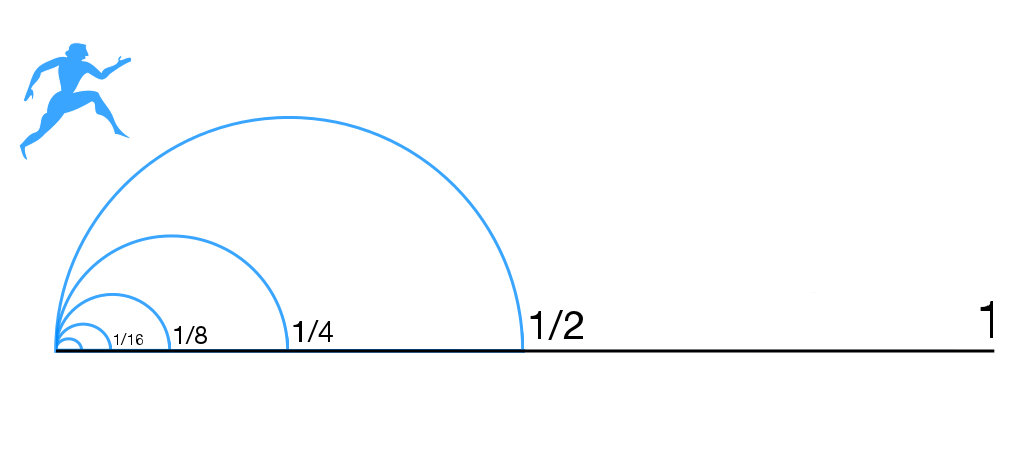
Consider the dichotomy paradox: That which is in locomotion must arrive at the half-way stage before it arrives at the goal.
Theoretically it’s impossible for any motion to begin because any motion to a certain destination requires travel of half that distance, but even that half distance has a half distance, so on and so forth and yada yada.
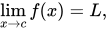
The modern math solution to this paradox: limit. My nightmares about calculus aside, limits are a great way to represent this mathematically:
The limit of f of x as x approaches c is L. You might also know that 0.99999… is mathematically equivalent to 1. This is also an example of a limit. The limit tells us that while we converge to a desired value, there isn’t a value of x that deterministically gives us L.
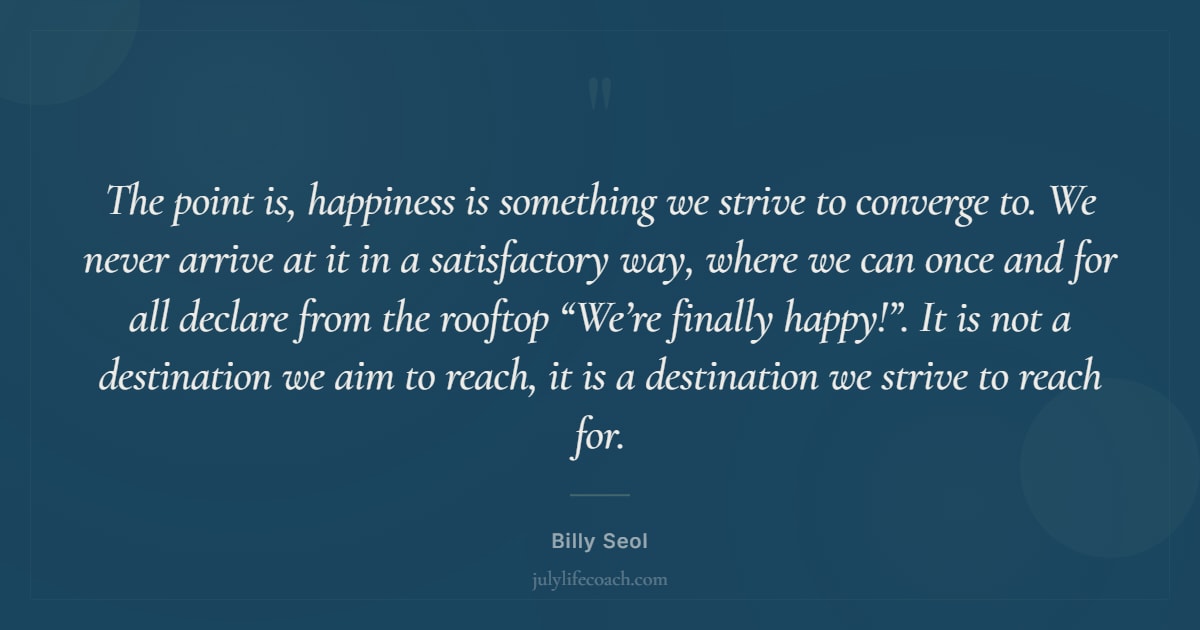
You might be wondering what the fuck this has to do with life coaching. The point is, happiness is something we strive to converge to. We never arrive at it in a satisfactory way, where we can once and for all declare from the rooftop “We’re finally happy!”. It is not a destination we aim to reach, it is a destination we strive to reach for.
This simple change in how we think about happiness has many positive effects for us. One, there is no differentiation between a good state and a bad state; we always simply are. Two, we never have to worry about “losing” on something we had because we never attain anything. Three, it gives us a very clear path forward in life: every day, we just take one more step towards happiness.
I’d say I’m a pretty happy fellow at this moment. But suppose I declare happiness and stop practicing. It will feel so sweet, when I sleep past 5AM. I’m going to feel so well rested, when I stop doing 108 bows. I’m going to have so much more time to do things, when I don’t meditate.
Then what will inevitably happen? It won’t feel as refreshing, it won’t feel as well resting, it won’t feel as freeing. I’ll start complaining about things more, I’ll start waking up later and later, I’ll be more reluctant to do things that require stamina out of me, in other words: I’m going to go right back to where I came from.
I don’t want to go back to that life. Suppose to my dismay I get total amnesia K-Drama style and I forget all the Buddhism I learned. Two things give me hope, even in that situation.
- Just like how you don’t forget how to ride a bike, my happiness is practiced and experienced by me. I cannot forget the practice of happiness because it is not knowledge, it is experience.
- Even in all of my previous suffering I found the dharma of the Buddha. I never even thought to look before but I found it. What I’ve learned to do isn’t something that’s exceptionally difficult; it’s the same whether it’s day 1 or day 1000, I just make one more step towards happiness and practice it.
This is sustainable happiness in the form of the convergence model. The convergence model isn’t something you understand; it’s something you verify through experience. If you want to start, here’s where I’d begin: Introduction to Buddhist Practice and the Practice App I built to support it.
Billy Seol
July Life Coach
julylifecoach.com